English



























Commercial Real Estate Investment Trends 2026 Insights

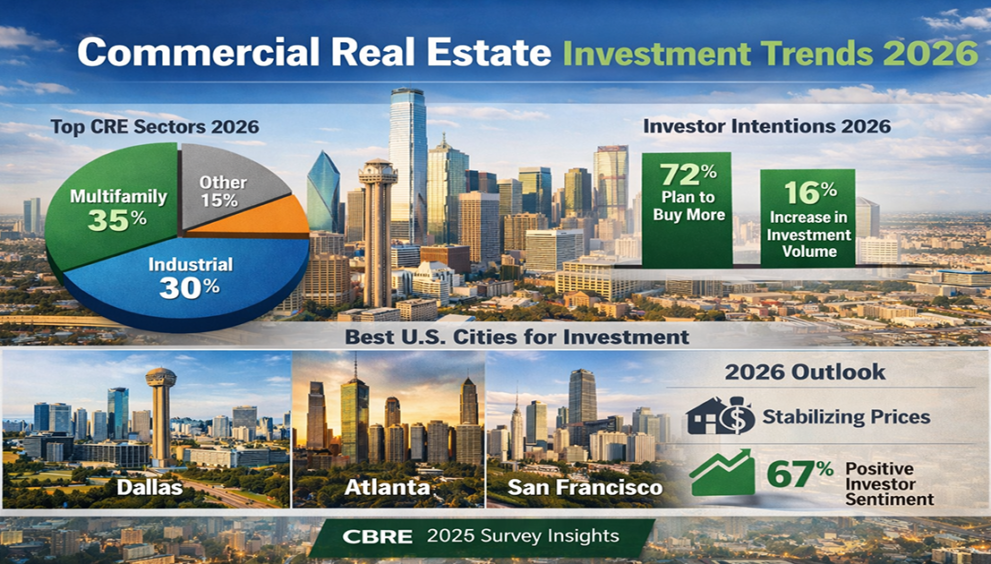
Commercial real estate investment trends for 2026 reveal a dynamic shift in the U.S. commercial real estate outlook, marked by renewed confidence among institutional and private investors. According to the CBRE North America Investor Intentions Survey insights, a substantial portion of market participants plan to increase capital deployment, reflecting optimism in North America commercial real estate investment even amid economic uncertainty. From commercial property investment data 2026 to evolving commercial real estate investor trends, current forecasts suggest an accelerating recovery in key sectors and expanding appetite for high-quality assets, prompting questions about where investors are putting money in commercial real estate and whether 2026 is a good year to invest in commercial real estate.
Commercial Real Estate Investment Trends: Data-Driven Outlook for 2026
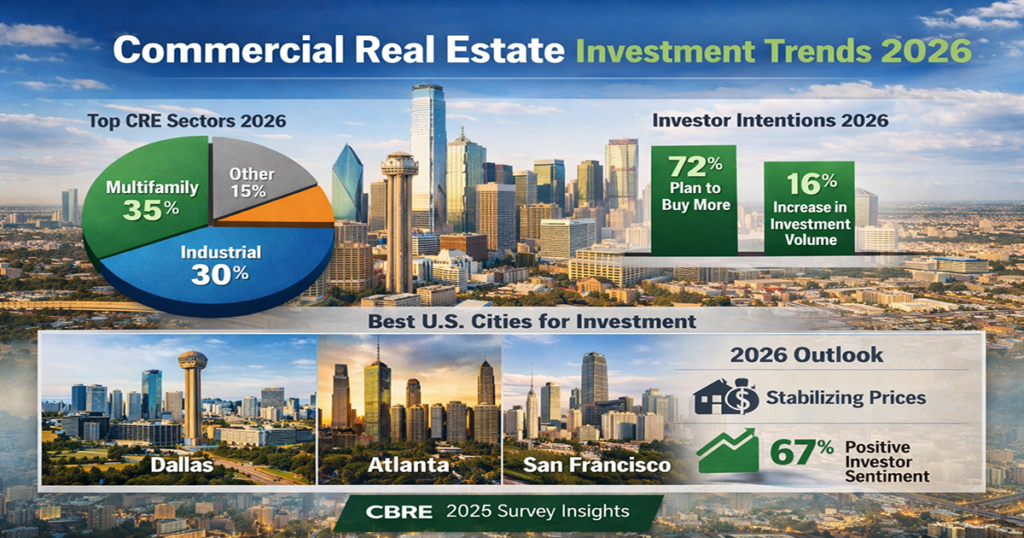
The landscape of commercial real estate investment trends is shifting as 2026 unfolds, informed by the latest industry data and investor surveys. The CBRE investor intentions survey shows a remarkable resurgence in investment sentiment after several years of caution. A significant majority of investors are preparing to increase their exposure to commercial assets in the U.S. this year, buoyed by stabilizing fundamentals and improving pricing dynamics. According to recent findings in the 2026 North America Investor Intentions Survey, nearly three-quarters of commercial real estate investors expect to acquire more assets in 2026 than they did in the prior year, signaling a pronounced shift toward capital deployment and market participation.
Despite macroeconomic headwinds, including concerns about inflation and labor market softness, commercial real estate investment activity in the U.S. is projected to grow substantially in 2026. Leading industry forecasts point to a 16 % increase in investment volume, narrowly approaching or matching pre-pandemic levels, underpinned by demand across key sectors such as multifamily, industrial, and select office markets.
Underpinning this forward momentum is a notable recovery in investor sentiment. Across U.S. markets, the expectation of near-term stability in borrowing costs—particularly long-term yields around 4 %—has encouraged institutional capital to re-enter the space. With this backdrop, commercial real estate investor trends in 2026 reflect a renewed readiness to commit capital to assets that demonstrate strong income prospects, scarcity of supply, or strategic value in long-term holding periods.
U.S. Commercial Real Estate Outlook: Sector Preferences and Market Signals
The U.S. commercial real estate outlook for 2026 is nuanced, shaped by divergent performances across property types. Multifamily real estate continues to lead investor demand, with a substantial portion of respondents targeting residential-driven assets due to stable income streams and resilient occupancy metrics. Industrial and logistics properties remain a close second, driven by strong e-commerce demand and supply chain realignments that prioritize quality distribution space. Office investment, while still cautious relative to other sectors, is showing signs of stabilization, especially for high-quality space in major markets where leasing demand is improving.
Dallas has emerged consistently as one of the most attractive U.S. markets for capital deployment, offering a blend of population growth, robust job creation, and positive leasing fundamentals. Atlanta and San Francisco also rank highly among investor preferences, with gateway markets in general attracting a consistent share of capital due to liquidity and tenant demand characteristics. Local market attractiveness plays a significant role in shaping commercial real estate capital deployment trends 2026, with secondary and high-growth markets reflecting increased investor interest.
Investor confidence in these trends is evident in capital allocation strategies. A majority of investors plan not only to acquire more properties but also to increase their overall real estate allocations compared with 2025. More than half of survey participants indicated intentions to raise capital commitments to commercial property relative to prior periods, highlighting a broader conviction in mid-cycle opportunities.
Commercial Real Estate Investor Trends: Sentiment and Strategy
The 2026 investor landscape suggests a cautious yet constructive sentiment where risk management and selective asset targeting are key tactical imperatives. Many market participants are favoring moderate-risk strategies such as value-add and core-plus approaches, aligning with the demand for stable income and capital preservation amid uncertain economic conditions. Less emphasis has been placed on opportunistic or high-leverage strategies, reflecting a marketplace that values disciplined underwriting and quality over speculative risk.
This renewed optimism is not without constraints. Interest rate uncertainty and debt conditions remain central variables in decision-making, with investors calibrating leverage ratios and financing structures cautiously. However, the general consensus among investors reflects a belief that pricing dislocations and selective repricing opportunities can be leveraged to generate long-term growth while mitigating exposure to cyclical risk factors.
Best U.S. Cities for Commercial Real Estate Investment
Selecting the optimal markets for commercial real estate deployment remains a priority for investors in 2026. Dallas continues to top rankings in investor intention surveys, offering an attractive blend of economic diversity, strong demographics, and robust demand across multiple sectors. Atlanta’s growing technology and corporate sectors, combined with favorable business conditions, make it another preferred destination. San Francisco’s repositioned office and tech-centric market is also gaining traction among investors seeking long-term growth. Broader Sun Belt metros are increasingly recognized for their favorable investment dynamics, including Charlotte, Nashville, Tampa, and Seattle.
Multifamily vs Office Investment Trends 2026
A clear divergence exists between multifamily and office investment trends in 2026. Multifamily real estate remains a cornerstone of investor strategy due to its predictable cash flows and resilience in varied economic conditions. Conversely, office markets have experienced a more heterogeneous recovery. While prime office properties in major urban centers show improved leasing activity and decreasing vacancy rates, the broader office sector continues to grapple with structural shifts in workplace utilization and remote work preferences. Nevertheless, selective high-quality office assets are attracting capital, particularly where long-term corporate leases and strategic repositioning opportunities are present.
2026 Commercial Real Estate Capital Deployment Trends
In addition to asset class preferences, several thematic trends are emerging in how investors deploy capital through 2026. A focus on quality assets and scarcity-driven pricing advantages is a recurrent theme, with many investors aligned on sectors where fundamentals are improving or supply constraints are intensifying. Secondary sectors—such as self-storage, healthcare-related properties, and specialized logistics segments—are increasingly considered as diversifiers within broader portfolios.
Capital markets data and commercial property investment data 2026 collectively reinforce the idea that quality of cash flows and location fundamentals are at the forefront of investment decisions. In many cases, this has translated into targeted acquisitions that prioritize stable income while positioning for capital appreciation as market dynamics normalize.
U.S. Commercial Property Investment Recovery 2026
Following years of recalibration, the U.S. commercial real estate market is witnessing a gradual recovery in 2026. The positive momentum is underpinned by stabilizing leasing fundamentals, a more balanced supply-demand equilibrium across major asset classes, and a renewed willingness among investors to commit capital. While challenges related to macroeconomic uncertainty and financing conditions persist, the prevailing narrative reflects a transition toward confidence and measured expansion.
Investor expectations for a recovery are supported by forecasts that investment volumes could rise significantly in 2026, bolstered by increased buyer activity and pricing convergence toward levels that attract institutional capital. This recovery narrative is further validated by evidence of rising acquisition intentions across investor segments and a broad consensus that 2026 offers a constructive environment for deploying capital in commercial real estate.
Investor Confidence in Commercial Real Estate 2026
Confidence among commercial real estate investors in 2026 can be attributed to a confluence of stabilizing market fundamentals, improved pricing trajectories, and constructive sentiment around future leasing activity. Surveys consistently show that a high percentage of investors plan to increase or maintain their investment activity relative to 2025, reflecting a robust belief in the sector’s long-term performance potential.
Despite uncertainties, investor confidence remains anchored by strong demographic trends, economic diversification across markets, and persistent demand for high-quality space. These factors collectively suggest that key components of the commercial real estate cycle are aligning to sustain investment momentum throughout 2026.
Final Perspective: Risk and Return Outlook for 2026
While thorough analysis confirms commercial real estate risk and return outlook 2026 is multifaceted, the prevailing theme is one of cautious optimism. Investors are engaging with selective strategies that balance risk, capital deployment, and return potential. Multifamily remains a dependable source of income returns, industrial and logistics continue to benefit from structural demand, and office markets are finding pockets of recovery. In this environment, disciplined selection and prudent capital allocation will be key determinants of success in commercial real estate investment through 2026.