English



















































































AI Network Slicing 5G Real-Time Automation Shift

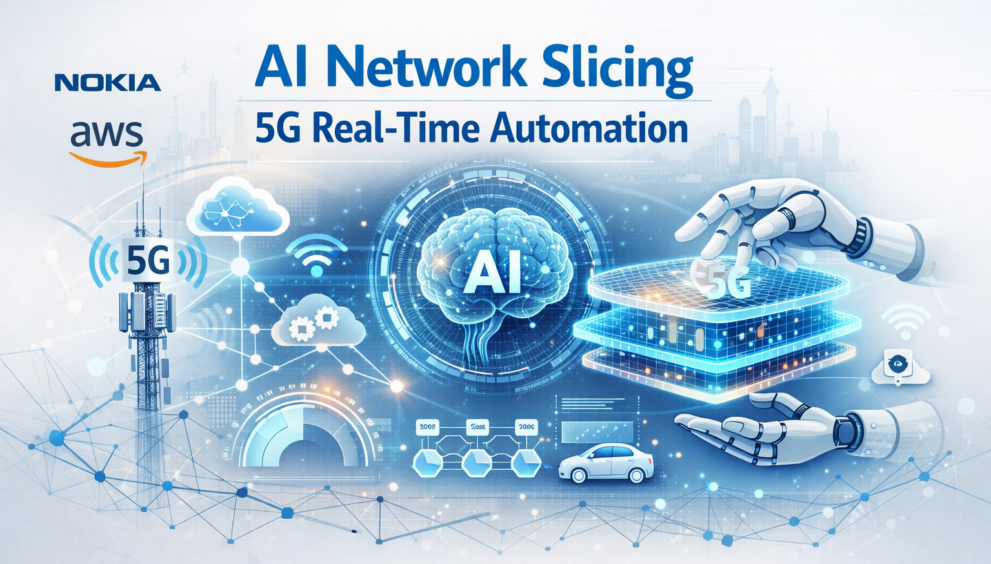
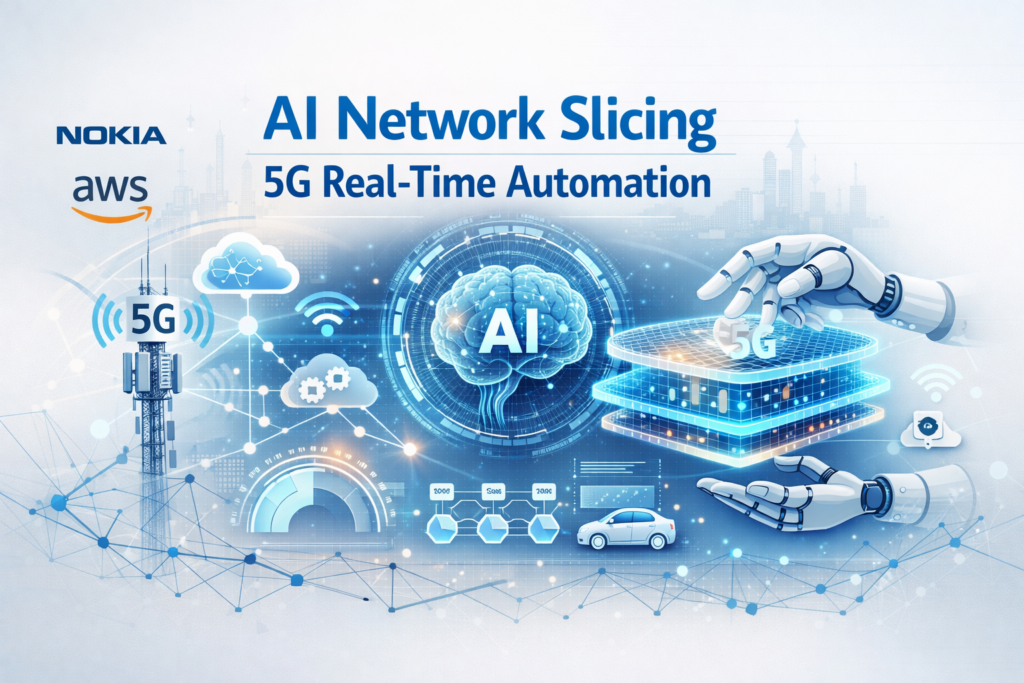
AI network slicing 5G real-time automation is emerging as a defining capability in next-generation telecom infrastructure. The Nokia AWS AI network slicing pilot signals a transition toward real-time 5G network slicing automation powered by agentic AI for 5G-Advanced slicing. This evolution introduces telecom AI network optimization at scale, where 5G network slicing AI agents dynamically manage resources. The Nokia and AWS agentic AI powered 5G-Advanced slicing solution demonstrates intent-based 5G slicing with AI agents in commercial networks, enabling AI-driven real-time 5G network resource management across distributed cloud-native environments.
The Strategic Shift Toward AI Network Slicing 5G Real-Time Automation
5G network slicing was originally positioned as a static orchestration framework, enabling operators to partition physical infrastructure into multiple virtual networks tailored for specific use cases such as enhanced mobile broadband, ultra-reliable low-latency communications, and massive IoT. However, static slicing models lack the responsiveness required for enterprise-grade service-level agreements, mission-critical applications, and dynamic traffic patterns.

AI network slicing 5G real-time automation represents a structural shift from rule-based provisioning to adaptive orchestration. Instead of manually configuring slices, operators deploy intelligent agents capable of monitoring network telemetry, predicting congestion, and adjusting parameters autonomously. This transition is aligned with broader 5G-Advanced and cloud-native transformation initiatives.
The move toward AI-driven real-time 5G network resource management is not incremental. It redefines operational models, cost structures, and monetization strategies within telecommunications ecosystems.
The Nokia AWS AI Network Slicing Pilot: A Commercial Milestone
The Nokia AWS AI network slicing pilot illustrates how hyperscale cloud and telecom infrastructure converge to operationalize real-time 5G network slicing automation. By combining telecom-grade network functions with advanced cloud AI services, the initiative demonstrates the viability of agentic AI for 5G-Advanced slicing in commercial environments.
The collaboration integrates cloud-native network functions with AI orchestration layers capable of processing high-volume telemetry streams. These AI agents analyze traffic flows, latency thresholds, and performance metrics, then trigger automated slice adjustments without human intervention. The outcome is improved efficiency, reduced manual configuration, and enhanced quality of service.
This Nokia and AWS agentic AI powered 5G-Advanced slicing solution moves beyond laboratory validation. It highlights how AI network slicing 5G real-time automation can function within live operator networks, aligning technical innovation with commercial deployment.
Agentic AI for 5G-Advanced Slicing: From Concept to Execution
Agentic AI refers to autonomous systems capable of goal-oriented decision-making. Within 5G networks, these agents interpret operator-defined intents such as latency targets, bandwidth guarantees, or enterprise service-level agreements. Rather than relying on predefined scripts, the agents continuously evaluate environmental variables and execute corrective actions.

Agentic AI for 5G-Advanced slicing enhances network responsiveness in several dimensions. Latency-sensitive applications such as industrial automation and connected healthcare require deterministic performance. AI-driven orchestration can preemptively allocate spectrum and compute resources to meet these demands. Similarly, event-driven traffic surges, such as live streaming or stadium events, can trigger automated scaling of slices in real time.
Intent-based 5G slicing with AI agents in commercial networks introduces a paradigm in which service definitions are translated into operational actions automatically. This reduces operational complexity while improving reliability and agility.
Telecom AI Network Optimization in Practice
Telecom AI network optimization extends beyond slicing configuration. It encompasses predictive analytics, anomaly detection, capacity forecasting, and automated remediation. AI network slicing 5G real-time automation serves as a focal point for these capabilities.
By ingesting network performance indicators, AI systems can identify congestion trends before service degradation occurs. Instead of reactive troubleshooting, networks shift toward proactive optimization. This transformation reduces mean time to repair and enhances overall customer experience.
Operational expenditure is also affected. Manual provisioning and monitoring processes are resource-intensive. Real-time 5G network slicing automation minimizes human intervention, enabling leaner operations while maintaining higher performance thresholds.
Commercial Implications of AI-Driven Real-Time 5G Network Resource Management
The commercial dimension of AI network slicing 5G real-time automation is significant. Enterprise customers increasingly demand customized connectivity profiles tailored to specific workloads. Manufacturing plants, logistics hubs, financial institutions, and media organizations require differentiated network characteristics.
AI-driven real-time 5G network resource management allows operators to provision enterprise-specific slices dynamically. Service tiers can be monetized based on performance guarantees rather than generic bandwidth metrics. This shift supports new revenue streams, including network-as-a-service and outcome-based connectivity models.
The Nokia AWS AI network slicing pilot suggests that hyperscaler partnerships accelerate this commercial evolution. Cloud-native integration reduces deployment friction and enhances scalability across geographic markets.
Architecture Foundations: Cloud-Native and Distributed Intelligence
AI network slicing 5G real-time automation depends on cloud-native architectures. Containerized network functions, microservices, and distributed data pipelines provide the agility required for real-time orchestration.
5G network slicing AI agents operate across control and management planes, interfacing with policy engines and analytics platforms. Data ingestion from radio access networks, core networks, and edge nodes feeds machine learning models. These models produce actionable insights that directly influence slice configuration.
Edge computing further amplifies this capability. Low-latency inference engines deployed at the edge enable faster decision-making for time-critical applications. The integration of AI with edge nodes ensures that network adjustments occur within milliseconds.
Risk Considerations and Governance
Despite its advantages, AI network slicing 5G real-time automation introduces governance considerations. Autonomous systems require transparent auditing frameworks to ensure regulatory compliance and service integrity. Explainability mechanisms are necessary to validate AI-driven decisions, particularly in sectors such as healthcare and finance.
Security also becomes a central concern. AI agents interacting with network control systems must be protected against adversarial manipulation. Robust authentication, encryption, and anomaly detection frameworks are essential components of a secure automation strategy.
Commercial adoption will depend on balancing innovation with operational resilience. Operators must demonstrate reliability before large-scale enterprise migration occurs.
Market Outlook: AI Network Slicing in 5G-Advanced Era
The transition toward 5G-Advanced intensifies the relevance of AI network slicing 5G real-time automation. Enhanced spectrum utilization, energy efficiency, and service customization require orchestration beyond traditional network management systems.
Industry momentum suggests that AI-driven slicing will become a baseline capability rather than a differentiator. Telecom AI network optimization platforms are expected to evolve into integrated intelligence layers embedded within core networks.
The Nokia and AWS agentic AI powered 5G-Advanced slicing solution provides an early blueprint for scalable deployment. As commercial validation expands, similar architectures are likely to proliferate across global operators.
Competitive Landscape and Ecosystem Dynamics
The ecosystem surrounding AI network slicing 5G real-time automation includes telecom vendors, hyperscale cloud providers, AI platform developers, and enterprise customers. Strategic alliances define competitive positioning.
Cloud providers contribute elastic compute capacity and AI toolchains. Telecom vendors deliver carrier-grade reliability and domain expertise. The convergence of these capabilities accelerates commercialization timelines.
Real-time 5G network slicing automation also influences regulatory frameworks. Governments seeking digital transformation prioritize infrastructure capable of supporting smart cities, autonomous transport, and Industry 4.0 initiatives. AI-enabled slicing aligns with these objectives.
Conclusion: AI Network Slicing 5G Real-Time Automation as Infrastructure Intelligence
AI network slicing 5G real-time automation represents a foundational shift in telecommunications engineering and commercial strategy. Through initiatives such as the Nokia AWS AI network slicing pilot, agentic AI for 5G-Advanced slicing is transitioning from theoretical construct to operational capability.
Telecom AI network optimization, 5G network slicing AI agents, and AI-driven real-time 5G network resource management collectively define the next phase of connectivity. Intent-based 5G slicing with AI agents in commercial networks establishes a framework for autonomous, scalable, and monetizable infrastructure.