English









































AI Is Reshaping the Construction Industry at Scale

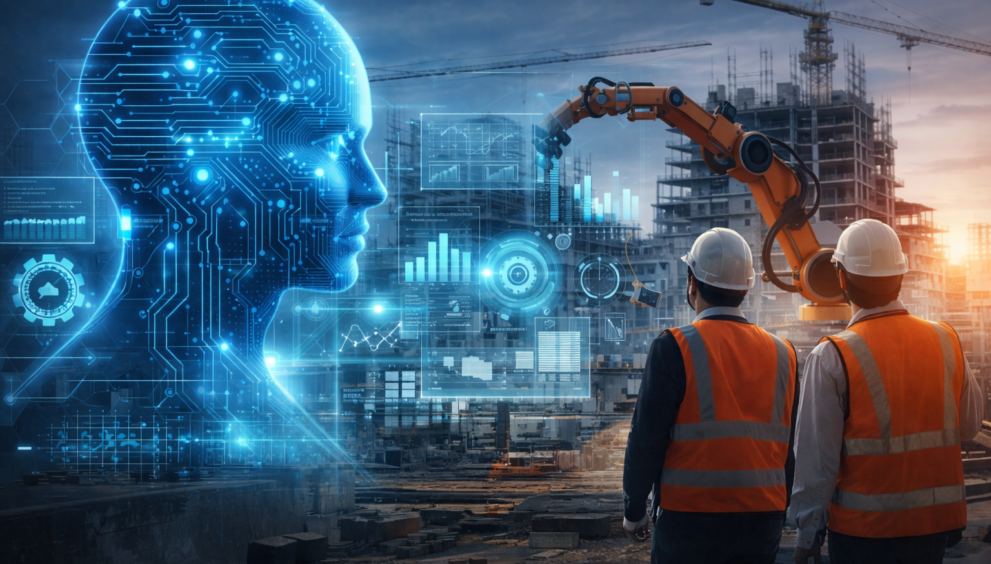
AI is accelerating change across the construction industry, shifting project delivery from experience-based judgment to data-driven execution. As adoption expands, AI for industry-wide transformation is redefining how construction firms plan, design, build, and manage assets. The construction industry, long characterized by fragmentation and inefficiency, is now leveraging AI to improve productivity, reduce risk, and enhance decision accuracy. With AI moving beyond pilot projects into enterprise-scale deployment, the construction industry stands at a pivotal moment where digital intelligence is becoming central to competitiveness and long-term sustainability.
AI Marks a Structural Shift in the Construction Industry
AI is no longer an experimental technology within the construction industry. It has emerged as a foundational capability that is reshaping operational models, project economics, and competitive dynamics. Historically reliant on manual processes and fragmented data, the construction industry now faces increasing pressure to deliver projects faster, safer, and more cost-effectively. AI adoption addresses these pressures by enabling predictive insights, automation, and real-time optimization at scale.
This transformation extends beyond isolated efficiency gains. AI in the construction industry represents a systemic shift toward intelligence-led execution, where decisions are informed by continuous data streams rather than static plans.
From Reactive Management to Predictive Intelligence
Traditional construction management has largely been reactive, addressing issues after delays or cost overruns occur. AI fundamentally alters this approach by enabling predictive intelligence. Machine learning models analyze historical and real-time data to forecast schedule slippage, cost escalation, and resource bottlenecks before they materialize.
In the construction industry, AI-driven forecasting improves planning accuracy and risk mitigation. Predictive analytics allow stakeholders to intervene earlier, allocate resources more effectively, and maintain tighter control over project outcomes. This shift has significant commercial implications, as reduced uncertainty directly improves margins and capital efficiency.
AI and Design Optimization in Construction
AI is transforming early-stage design processes within the construction industry by enhancing modeling accuracy and scenario analysis. Advanced algorithms can rapidly evaluate thousands of design permutations, balancing cost, materials, sustainability, and structural integrity. This capability enables more informed decision-making during project inception, where changes are least expensive and most impactful.
AI-supported design optimization shortens planning cycles and improves constructability, reducing downstream rework. As a result, AI for industry-wide transformation begins at the conceptual phase and extends throughout the project lifecycle.
Automation and Productivity Gains on Construction Sites
On-site productivity has long been a challenge for the construction industry. AI-powered automation is addressing this constraint through robotics, computer vision, and autonomous equipment. These technologies enhance precision, consistency, and safety while reducing reliance on scarce skilled labor.
Computer vision systems powered by AI monitor site activity, track progress, and identify safety risks in real time. Automation of repetitive tasks improves output predictability and reduces human error. These gains translate into measurable commercial value by lowering incident rates, minimizing delays, and stabilizing labor costs.
Workforce Augmentation Rather Than Replacement
AI adoption in the construction industry is often misunderstood as a threat to employment. In practice, AI functions primarily as a workforce augmentation tool rather than a replacement mechanism. AI systems enhance human decision-making by processing complex datasets at speeds beyond manual capability.
Skilled professionals increasingly rely on AI-generated insights to prioritize tasks, assess risks, and optimize workflows. This collaboration between human expertise and artificial intelligence supports higher-value roles while improving overall project performance.
Data Integration and Platformization
The construction industry has historically struggled with data silos across design, procurement, and execution. AI thrives on integrated data environments, accelerating the industry’s move toward platform-based operating models. Centralized data platforms powered by AI enable real-time collaboration and transparency across stakeholders.
AI-driven data integration improves coordination between owners, contractors, and suppliers. This platformization enhances accountability and supports more accurate reporting, strengthening trust and governance in complex construction ecosystems.
Commercial Implications of AI Adoption
From a commercial investigation perspective, AI adoption reshapes cost structures and investment strategies within the construction industry. While initial implementation requires capital expenditure, the return on investment emerges through reduced rework, fewer disputes, and improved asset performance.
AI enables firms to bid more accurately, manage risk exposure, and differentiate through reliability. As AI becomes a standard capability, competitive advantage will increasingly depend on how effectively organizations integrate intelligence into core operations.
Risk Management and Compliance Through AI
Regulatory compliance and risk management are critical concerns in the construction industry. AI enhances these functions by continuously monitoring compliance indicators, safety protocols, and contractual obligations. Automated compliance checks reduce administrative burden while improving accuracy.
AI-powered risk management systems identify patterns associated with disputes, claims, and safety incidents. Early detection enables proactive intervention, reducing financial exposure and reputational risk. This capability strengthens organizational resilience in a high-risk operating environment.
AI and Sustainability in Construction
Sustainability has become a strategic priority across the construction industry. AI supports sustainability goals by optimizing material usage, reducing waste, and improving energy efficiency. Predictive models assess environmental impact across project stages, enabling data-driven sustainability decisions.
AI-driven optimization aligns environmental responsibility with commercial performance. Reduced waste and improved efficiency lower costs while supporting regulatory compliance and stakeholder expectations.
Barriers to Industry-Wide AI Transformation
Despite its potential, AI adoption across the construction industry faces structural barriers. Data quality, legacy systems, and cultural resistance remain significant challenges. Successful AI for industry-wide transformation requires investment not only in technology but also in change management and skills development.
Organizations that treat AI as a strategic capability rather than a standalone tool are more likely to achieve sustained benefits. Leadership commitment and cross-functional alignment are critical to overcoming adoption barriers.
The Competitive Divide in AI Adoption
As AI maturity increases, the construction industry faces a growing competitive divide between early adopters and laggards. Firms that embed AI into decision-making processes gain compounding advantages in efficiency, predictability, and scalability.
This divide has long-term implications for market consolidation and competitive positioning. AI-enabled firms are better equipped to manage complex projects, attract capital, and respond to economic volatility.
AI as a Catalyst for Industry-Wide Transformation
AI represents more than incremental improvement for the construction industry. It serves as a catalyst for industry-wide transformation, redefining how projects are conceived, delivered, and operated. Intelligence-driven construction models emphasize predictability, transparency, and continuous optimization.
As AI capabilities mature, integration across the asset lifecycle will deepen, creating feedback loops that further enhance performance and value creation.
Conclusion: AI Redefines the Future of the Construction Industry
AI is reshaping the construction industry by introducing intelligence at every stage of the project lifecycle. From predictive planning and design optimization to automation and risk management, AI for industry-wide transformation is redefining operational and commercial norms.
The construction industry’s future competitiveness will increasingly depend on the ability to harness AI as a core capability. Organizations that align technology investment with strategic intent and workforce development will be best positioned to thrive in an intelligence-driven construction landscape.