English
















































































AI Search Revolution: AEO vs GEO and the Future of Digital Visibility

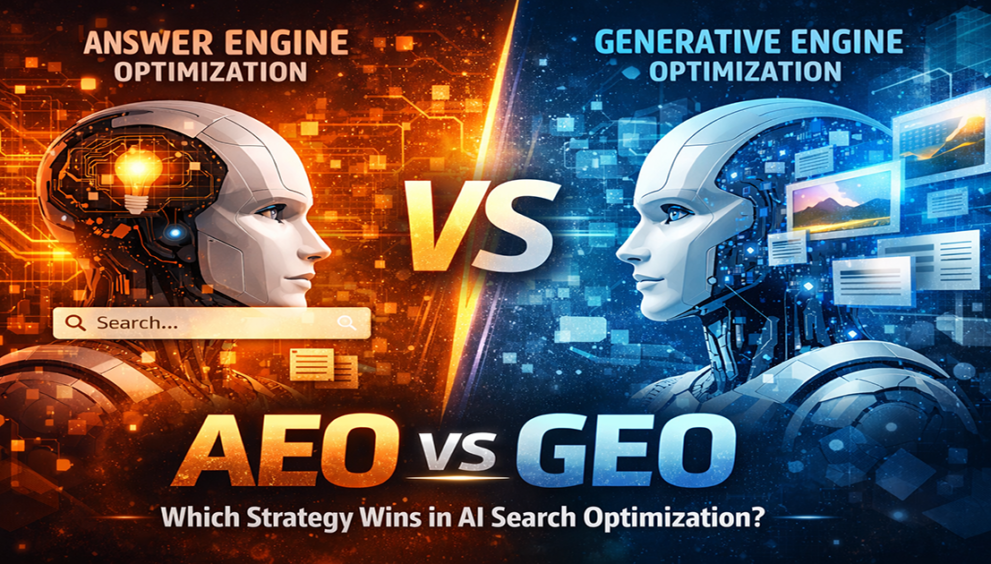
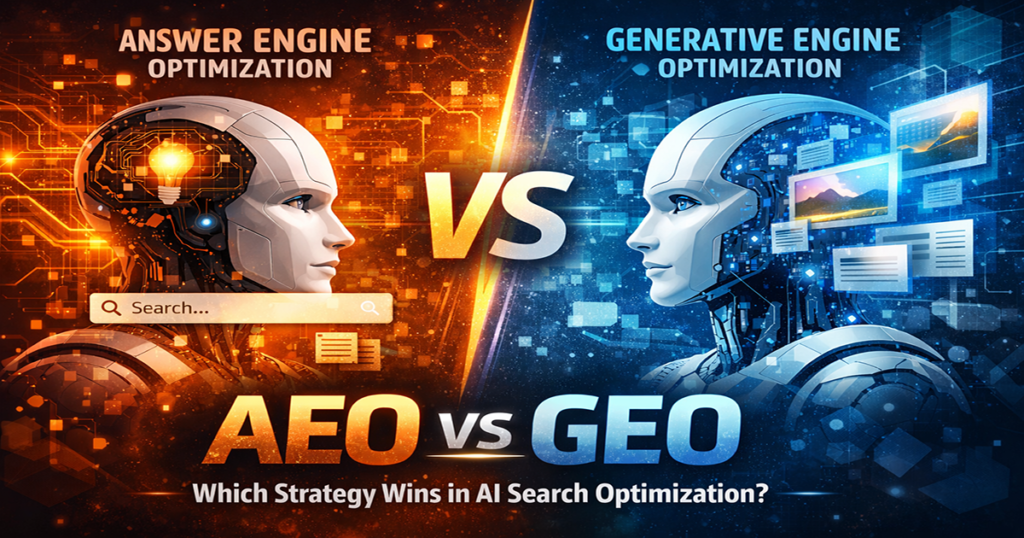
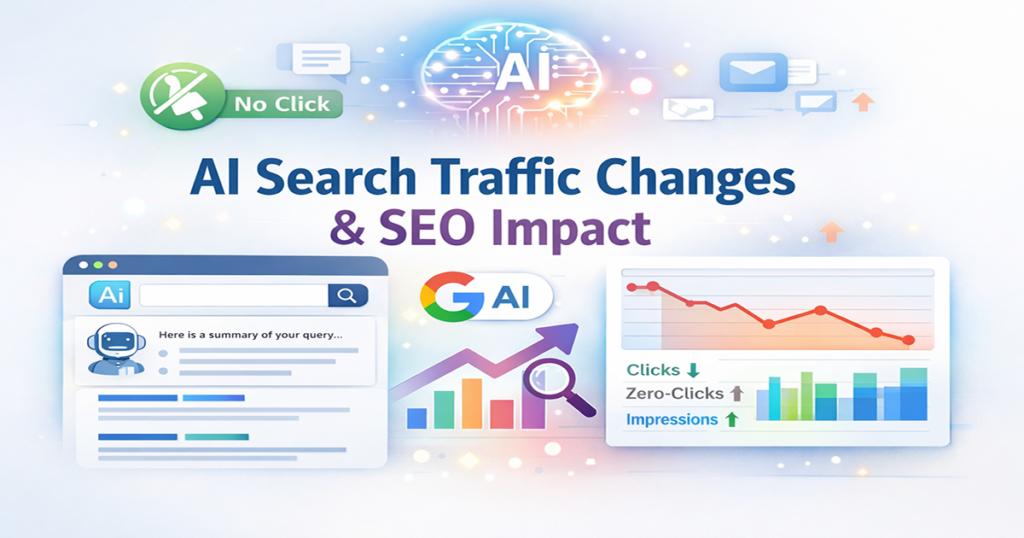
Artificial intelligence is transforming the search landscape by redefining how systems discover and deliver information. Traditional search engines relied on keyword indexing; however, modern platforms now interpret intent and context with precision. As a result, Answer Engine Optimization (AEO) and Generative Engine Optimization (GEO) have become essential components of AI search optimization. Moreover, users increasingly prefer conversational and zero-click search experiences. Consequently, businesses must align their content strategies with AI-powered search marketing models. Therefore, a clear understanding of AEO vs GEO is critical for maintaining visibility and authority in 2026.
AEO vs GEO: The Future of AI Search Optimization
Understanding AEO: Answer Engine Optimization

Answer Engine Optimization (AEO) shifts the focus from ranking pages to delivering direct answers. Instead of relying on traditional SERP positions, AEO enables content to appear instantly within AI-driven responses. Furthermore, AEO uses structured data, semantic clarity, and concise formatting to improve extraction accuracy. AI systems analyze this structure and deliver precise answers to user queries. In addition, AEO targets high-intent searches, ensuring content directly satisfies user needs. Therefore, organizations that implement AEO gain stronger visibility in zero-click environments and strengthen their authority in AI ecosystems.
Understanding GEO: Generative Engine Optimization
Generative Engine Optimization (GEO) focuses on shaping how AI systems generate responses. Unlike AEO, GEO operates in environments where AI models synthesize information from multiple sources. Consequently, content must demonstrate authority, depth, and contextual relevance. AI systems evaluate relationships between topics and prioritize content that provides comprehensive insights. Moreover, consistent publishing across platforms reinforces trust signals. Thus, GEO enables brands to influence AI-generated narratives and improve visibility within generative AI search engines.
AEO vs GEO: Core Differences
AEO and GEO serve distinct but complementary roles in AI search optimization. AEO delivers direct answers, whereas GEO shapes broader AI-generated outputs. For example, AEO depends on structured data and precise responses. In contrast, GEO relies on contextual depth and topical authority. Similarly, AEO targets immediate query resolution, while GEO supports continuous content generation. As a result, combining AEO and GEO creates a more effective AI-powered search marketing strategy.
The Rise of Generative AI Search Engines
Generative AI search engines have redefined the search experience by eliminating the need for traditional navigation. Instead of presenting a list of links, these systems generate comprehensive responses that integrate multiple data sources. This shift has significant implications for digital marketing. Visibility is no longer determined solely by rankings but by inclusion within AI-generated responses. This creates a new competitive landscape where content must be optimized for AI interpretation rather than human browsing alone. AI search optimization now requires alignment with machine learning models that prioritize contextual understanding, semantic relationships, and content authority. Generative AI search engines evaluate content based on relevance, credibility, and coherence within broader knowledge frameworks. The transition to generative search has accelerated the importance of GEO, as businesses seek to influence how their content is represented within AI-generated outputs.
AI-Powered Search Marketing in 2026
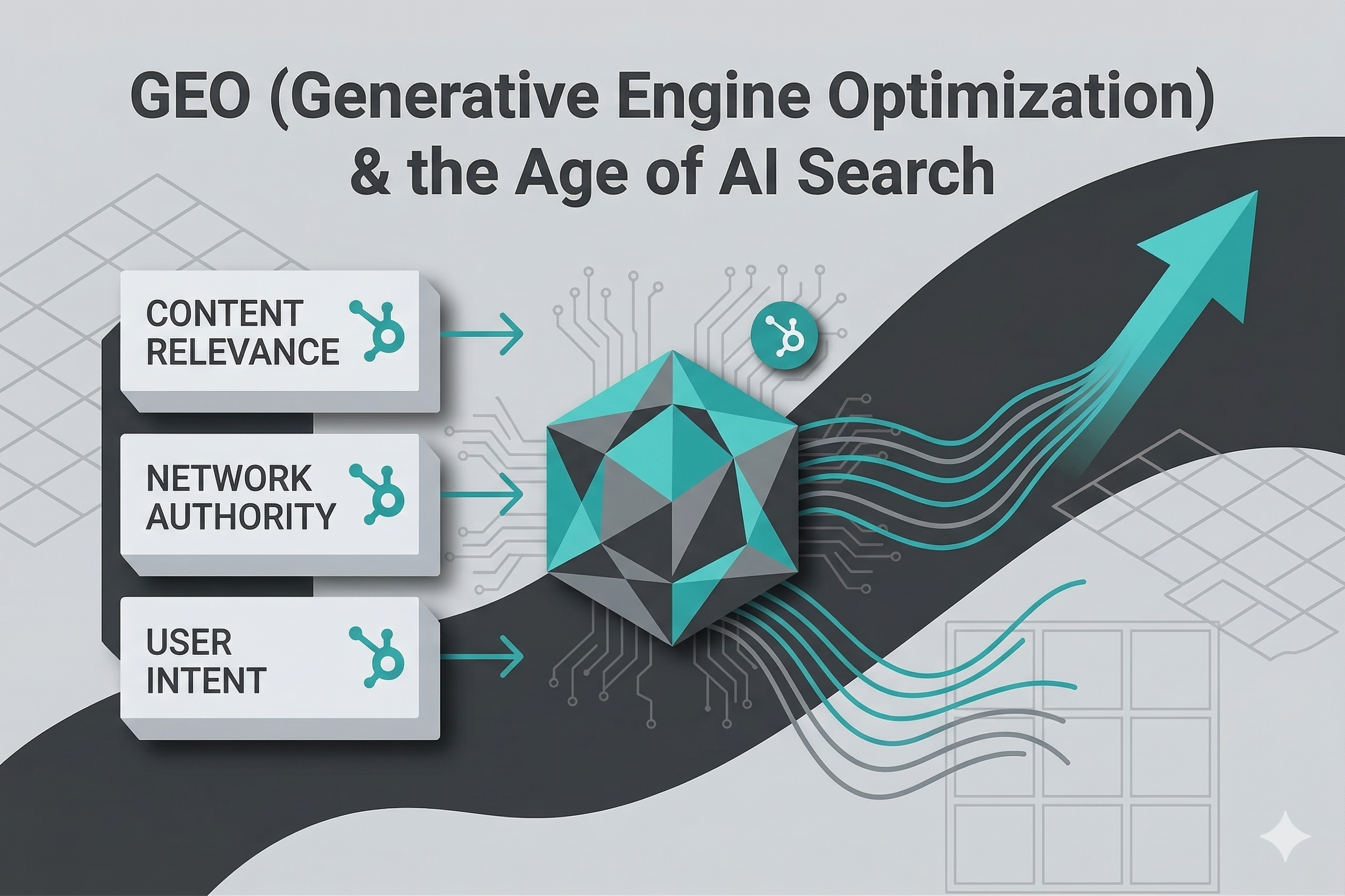
AI-powered search marketing has evolved into a multi-layered discipline that integrates AEO, GEO, and traditional SEO. The convergence of these strategies reflects the complexity of modern search ecosystems. Marketing strategies now require a dual approach that addresses both retrieval-based and generative systems. This involves optimizing content for direct answers while also ensuring its inclusion in generative outputs. The integration of AI into search has introduced new performance metrics, including answer visibility, generative inclusion rates, and contextual relevance scores. These metrics provide a more comprehensive understanding of content performance in AI-driven environments. The role of AI-powered search marketing extends beyond visibility to influence user perception and decision-making. Content that appears within AI-generated responses carries implicit authority, shaping brand credibility and trust.
Best Practices for Generative Engine Optimization (GEO)
Organizations should follow best practices for generative engine optimization GEO by focusing on authority and semantic depth. First, teams must build comprehensive content clusters that cover interconnected topics. Next, they should maintain consistency across all digital platforms. This approach strengthens AI recognition and improves trust signals. Additionally, teams must structure data to support machine readability and integration into AI systems. Finally, organizations should continuously refine their content strategies to adapt to evolving generative AI search engines.
How to Optimize Content for AI Search Engines
Content teams should adopt a hybrid strategy to optimize content for AI search engines. Initially, they must create structured answers that address specific queries. Then, they should expand content to include deeper contextual insights. Moreover, teams should implement semantic optimization to improve AI interpretation. At the same time, they must align content with natural language patterns used in conversational search. Therefore, this combined approach strengthens visibility across both answer engines and generative platforms.
AEO vs GEO Strategy for Digital Marketing
An effective AEO vs GEO strategy for digital marketing requires integration rather than selection. Both approaches address different aspects of AI search optimization, making them complementary rather than competitive. AEO ensures visibility in immediate-answer environments, capturing high-intent queries and driving direct engagement. GEO ensures presence within generative ecosystems, influencing broader discovery and brand perception. The strategic alignment of AEO and GEO involves creating content that is both structured and context-rich. This includes developing content clusters, implementing schema markup, and maintaining narrative consistency. Digital marketing strategies must also adapt to evolving user behavior, which increasingly favors conversational interactions and AI-driven discovery. This shift underscores the importance of integrating AEO and GEO into a unified framework.
Commercial Implications of AEO vs GEO
The commercial impact of AEO vs GEO is significant, affecting lead generation, customer acquisition, and brand positioning. Businesses that effectively leverage these strategies gain a competitive advantage in AI-driven markets. AEO drives immediate conversions by providing direct answers to user queries. GEO influences long-term brand perception by shaping how AI systems present information. The integration of AEO and GEO enhances customer journeys, enabling seamless transitions from discovery to decision-making. This creates opportunities for personalized marketing and targeted engagement. Commercial success in AI-powered search marketing requires continuous adaptation, as AI systems evolve and user expectations change.
The Future of AI Search Optimization

The future of AI search optimization lies in the convergence of AEO, GEO, and advanced AI technologies. As generative AI continues to evolve, the distinction between retrieval and generation will become increasingly blurred. Content strategies will need to prioritize adaptability, ensuring compatibility with emerging AI systems and platforms. This includes leveraging advanced data structures, machine learning insights, and real-time optimization techniques. The role of AI in search will expand beyond information retrieval to include decision support, predictive analytics, and personalized recommendations. This will further elevate the importance of GEO in shaping AI-generated experiences. AEO will continue to play a critical role in delivering precise answers, particularly in high-intent scenarios. The combination of AEO and GEO will define the next generation of search optimization.
Conclusion
The debate around AEO vs GEO reflects a broader transformation in the digital landscape, driven by the rise of AI-powered search systems. Answer Engine Optimization and Generative Engine Optimization represent two distinct but interconnected approaches to content visibility and influence. AEO focuses on precision, enabling content to serve as direct answers within AI-driven interfaces. GEO focuses on influence, shaping how content is generated and presented within AI ecosystems. Together, they form the foundation of modern AI search optimization. As generative AI search engines continue to redefine user interactions, the integration of AEO and GEO will become essential for maintaining visibility and relevance. Businesses that adopt a comprehensive approach to AI-powered search marketing will be better positioned to navigate the evolving digital landscape and achieve sustainable growth.