English



























































How Visual Branding Content Enhances Digital Education Content Effectiveness


Visual branding in digital education works. Find out why students remember more information and stay engaged when learning combines text with relevant images.
Reflect on the last time you scrolled through social media. What made you stop? Probably not a wall of text, but rather a striking image or eye-catching design. Our brains process visuals 60,000 times faster than text, and this principle applies equally to education.
Visual branding in digital education has evolved beyond simply adding logos to course materials. It’s about creating consistent, memorable learning experiences that genuinely stick.
When educational institutions combine colors, graphics, and design elements, students learn better and stay engaged longer. In this post, I’ll share how visual branding in digital education has become essential to modern teaching.
How Our Brains Process Visual Information
Your brain can only handle so much working power when you are learning something new. Reading dense text quickly drains this, but information paired with relevant images lasts much longer.
Dual coding theory shows we process verbal and visual information through separate channels. It is easier to learn when both of them work together. It’s like having two roads that lead to the same place instead of one.
According to Science ABC, our brain can identify and understand images in just 13 milliseconds, while text takes several seconds to process. That’s precisely why making a useful banner for your online course isn’t just decoration; it’s also a good way to get your message across.
Visual branding in digital education leverages this by presenting concepts through multiple sensory pathways, which makes difficult ideas much easier to understand.
Why Visuals Stick in Memory
Three days after hearing information, people remember only 10% of it. Add a relevant visual, and that number jumps to 65%. Psychologists call this the ‘picture superiority effect.
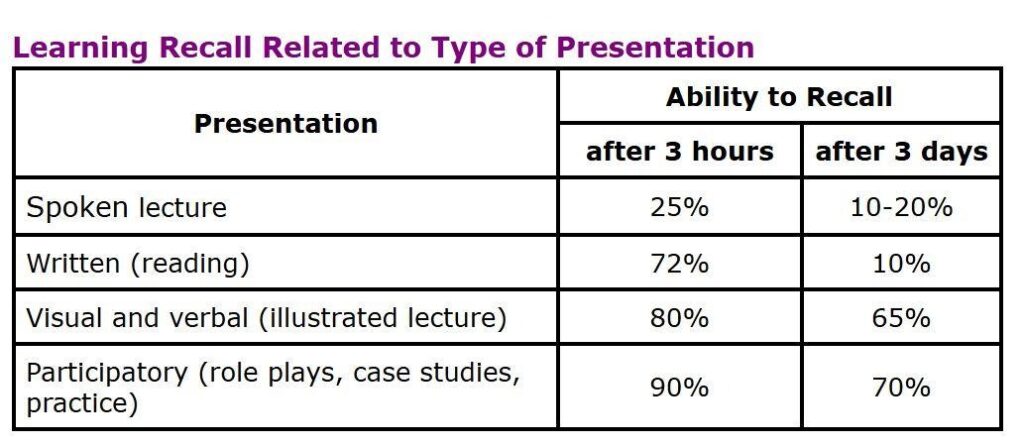
Image via Changing Minds
Your brain creates bigger, easier-to-find mental files for pictures than words alone. The application of visual branding in digital education takes advantage of this biological reality.
Visual cues, such as logos, colours, and design patterns, that are repeated in students’ learning tools help them remember what they have read. Making it easier to remember things during tests or practical applications.
Elements That Matter
For visual branding to function in digital education, a few crucial parts need to work together. Below are parts that make up the foundation for memorable learning experiences.
Consistent Visual Identity
Consider taking a course where every module looks completely different. Clashing colours, random logo placements and inconsistent fonts. Chaotic, right? That’s exactly what poor branding does to the learning experience.
Consistency builds trust and reduces mental effort. When students know what to expect visually, they can focus on the information rather than constantly adjusting to new layouts.
Image via Harvard
Major universities like Harvard maintain their crimson red across every digital touchpoint from lecture slides to discussion forums. This level of attention to visual branding in digital education creates prestige and cohesion that students take on as part of their learning identity.
Infographics and Data Visualization
Anyone can get tired of looking at raw numbers, but what if you turn them into clean charts or engaging infographics? Suddenly they’re interesting and memorable. A lot of the time, educational material includes complex data, like test scores, timelines of events in history, and scientific processes.
Visual branding in digital education means presenting this information in u ways that our brains can easily understand. Not only does data visualization make things clear, but it also tells stories. When biology courses use branded infographics to show how cells divide or business classes make custom charts for market research, they’re telling stories that students can
Color Psychology in Learning
Colors aren’t neutral. Blue tends to promote focus and calm. Red can increase energy but also stress. Yellow stimulates creativity but too much of it can be overwhelming.

Image via The University of Tennessee
The University of Tennessee’s distinctive orange creates immediate recognition. When their online courses use that same orange consistently in headers and graphics, students mentally connect the color with learning and achievement.
Impact on Learning
Theory is valuable, but what counts is how visual branding affects student outcomes. Here are some compelling evidence of its effectiveness.
Increased Student Engagement
Let’s be honest, attention spans are tested constantly in our scroll-heavy world. Generic, text-heavy courses lose students fast.
However, courses with strong visual elements hold attention better. Part of this comes down to social media conditioning. Platforms like Instagram have trained us to expect visual interest.
When visual branding in digital education includes custom graphics, thoughtful colour schemes, and professional layouts, this signals quality that students respond to positively.
Better Accessibility for Diverse Learners
Visual branding in digital education improves accessibility for diverse learners. Not everyone processes text the same way. When course creators thoughtfully incorporate visuals such as diagrams, flowcharts, and illustrated examples, they make it easier for anyone to grasp the same knowledge.
Students who struggle with written explanations might grasp concepts more quickly when they are visualised. For international students, visuals can overcome language barriers in ways that even well-written text can’t.
Practical Applications
It’s one thing to understand the principles; applying them is another. Here’s how platforms and institutions put visual branding into practice.
Course Materials and E-Learning Platforms
Khan Academy’s success didn’t happen by accident. Their visual approach—clean interfaces, consistent colors, friendly illustrations—makes learning feel approachable rather than intimidating. Every video, practice problem, and progress indicator uses the same visual language.
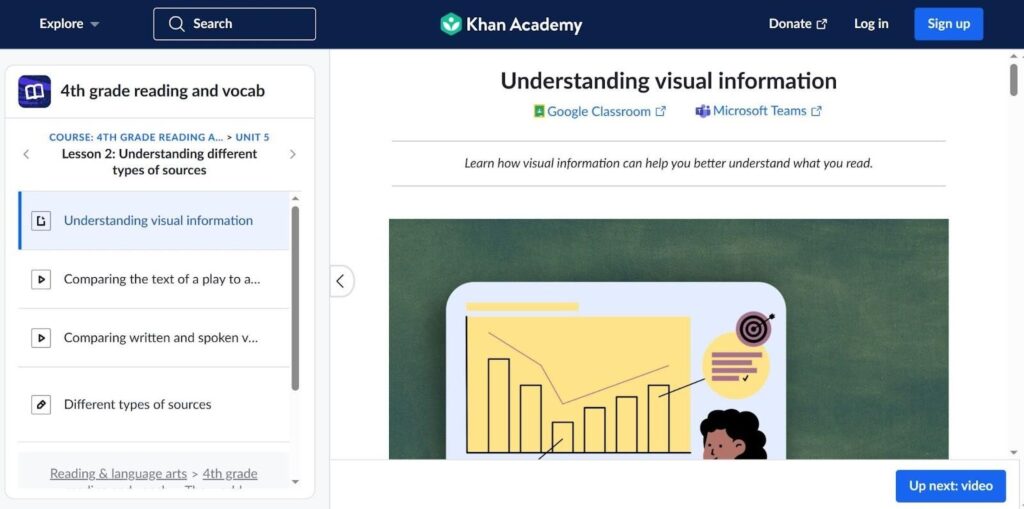
Image via Khan Academy
Independent creators can apply these same principles of visual branding in digital education by establishing clear guidelines from the start. This investment pays substantial dividends in higher completion rates and better student feedback.
Social Media Marketing
Educational institutions increasingly rely on social media to reach potential students. In this case, visual aspects are very important. People’s first impressions of you are often based on your Instagram feed, LinkedIn posts, and YouTube previews.
Strong visual branding in digital education means your content is instantly recognizable as students scroll.
Consistency builds familiarity and trust. If you’re managing multiple brands or large content calendars, it might make sense to hire a personal assistant to maintain visual consistency across all platforms.
Video Content and Multimedia
Video has become the dominant format for delivering educational content. Most of the time, educational YouTube channels that do well have unique visual styles, like intro animations, text overlay designs that don’t change, and thumbnail forms that are easy to recognize.
These aren’t merely aesthetic choices; they’re strategic applications of visual branding in digital education.
Frequently Asked Questions
1. What is visual branding in digital education?
Visual branding in digital education is the consistent use of design elements such as colors, graphics, and typography to improve comprehension, retention, and learner engagement.
2. What types of visuals work best in online courses?
Infographics, diagrams, real-life photographs, branded charts, consistent color schemes, and short videos work best because they simplify complex ideas and maintain engagement.
3. How can I ensure my visuals are accessible to all learners?
Use alt text, strong color contrast, clear text labels, and test visuals across devices to ensure they support diverse learning needs.
4. Why is visual branding important in digital education?
It improves engagement, comprehension, and retention by aligning content with how the brain learns.
Conclusion
For the most part, our brains are wired to process pictures faster and remember them longer than text. Educational content that ignores this biological reality fights an unnecessary uphill battle.
Visual branding in digital education isn’t about making things pretty, although there’s nothing wrong with aesthetically pleasing design. It has to do with how people learn.
When educators apply these principles thoughtfully, consistent colours, memorable graphics, smart infographics, strategic multimedia use, they create environments where students thrive.