English
























































































OpenAI Tata AI Data Center Deal Signals 1GW Push

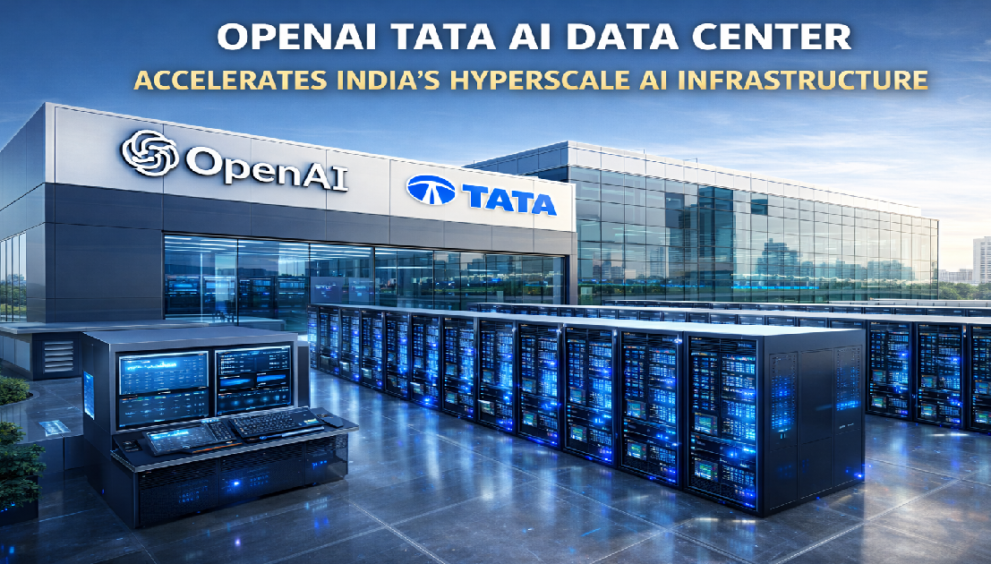
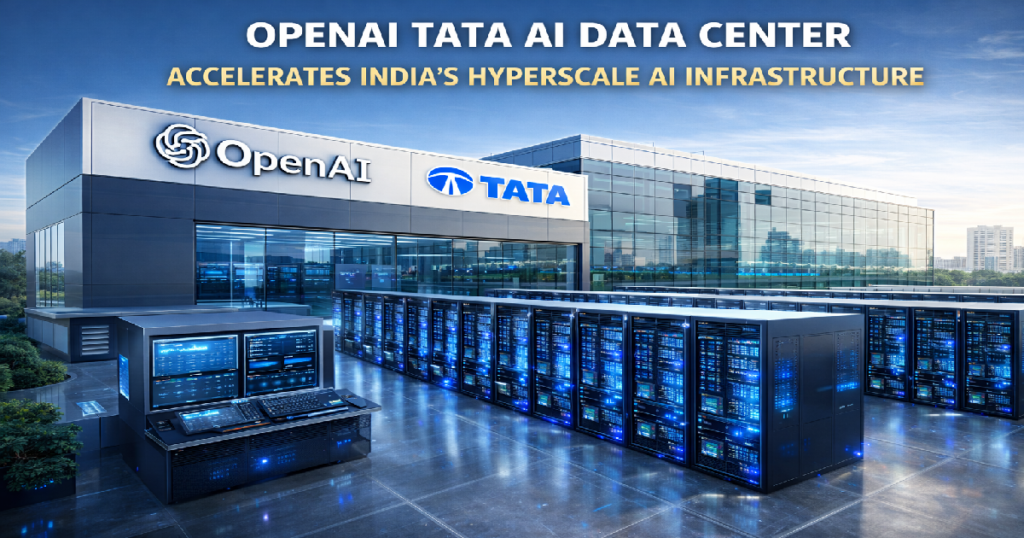
The OpenAI Tata AI data center initiative marks a decisive shift in India’s artificial intelligence infrastructure landscape, as OpenAI taps Tata for 100MW AI-ready capacity with ambitions to scale toward a 100MW to 1GW AI data center footprint. Anchored by Tata HyperVault AI infrastructure, the move supports accelerating enterprise demand and the ChatGPT Enterprise Tata rollout across regulated and large-scale industries. As OpenAI data center expansion and enterprise AI adoption in India converge, the Tata Group and OpenAI strategic AI partnership is emerging as a catalyst with long-term implications for the national AI ecosystem.
OpenAI Tata AI Data Center: India’s Hyperscale AI Moment
The OpenAI Tata AI data center partnership represents a structural inflection point for artificial intelligence deployment in India. The agreement to secure an initial 100MW of AI-ready data center capacity, with a roadmap extending toward 1GW, reflects both immediate compute demand and long-range confidence in India as a core AI growth market. Unlike incremental cloud expansion, this initiative signals hyperscale intent aligned with advanced model training, inference workloads, and enterprise-grade AI services.
India’s AI market has historically been constrained by limited high-density compute availability. The OpenAI Tata AI data center collaboration directly addresses this constraint by pairing OpenAI’s model and platform leadership with Tata’s industrial-scale infrastructure capabilities. The result is a foundation designed for sustained AI throughput rather than short-term experimentation.
Tata HyperVault AI Infrastructure as the Backbone
Tata HyperVault AI infrastructure sits at the center of this deployment strategy. Built to support high-performance GPU clusters, accelerated networking, and advanced cooling architectures, HyperVault facilities are positioned for energy-intensive AI workloads. AI data centers differ fundamentally from traditional enterprise data centers due to power density, thermal management, and low-latency interconnect requirements.
The 100MW to 1GW AI data center roadmap underscores a modular scaling approach. Initial capacity enables rapid onboarding of enterprise customers, while phased expansion aligns capital investment with demand growth. This structure reduces deployment risk while maintaining readiness for exponential scale.
For Tata Group, the partnership elevates HyperVault from a domestic infrastructure platform to a globally relevant AI hosting environment. For OpenAI, it provides localized compute sovereignty, latency reduction, and compliance alignment critical for enterprise adoption in India.
OpenAI Taps Tata for 100MW AI-Ready Data Center Capacity in India
The decision that OpenAI taps Tata for 100MW AI-ready data center capacity in India reflects strategic calculus rather than opportunistic expansion. India offers a large developer base, rapidly digitizing enterprises, and government-led AI adoption initiatives. However, AI workloads require more than cloud availability; they require deterministic performance and predictable scaling.
The initial 100MW allocation allows OpenAI to deploy advanced inference and enterprise workloads close to customers. Latency-sensitive applications such as conversational AI, analytics augmentation, and real-time decision systems benefit directly from local infrastructure. As demand scales, expansion toward 1GW positions India among the world’s leading AI compute hubs. This move also signals confidence in India’s energy and infrastructure reliability to sustain AI at scale. Power availability, grid stability, and renewable integration are increasingly central to AI data center planning.
ChatGPT Enterprise Tata Rollout and Commercial Impact
The ChatGPT Enterprise Tata rollout is a key commercial driver behind the OpenAI Tata AI data center strategy. Enterprise deployments require strict data residency, security controls, and predictable service-level agreements. Localized AI infrastructure addresses these requirements more effectively than offshore compute.
Large Indian enterprises across IT services, finance, manufacturing, healthcare, and telecommunications are accelerating generative AI adoption. ChatGPT Enterprise enables controlled deployment of advanced language models while integrating with internal systems. The proximity of AI compute reduces latency and enhances performance consistency, critical for mission-sensitive use cases.
Commercially, this creates a flywheel effect. As more enterprises adopt ChatGPT Enterprise, compute demand increases, justifying accelerated expansion from 100MW toward higher capacity thresholds. Infrastructure availability, in turn, lowers barriers for additional enterprise onboarding.
Tata Group and OpenAI Strategic AI Partnership
The Tata Group and OpenAI strategic AI partnership extends beyond infrastructure provisioning. It reflects convergence between industrial-scale execution and frontier AI innovation. Tata’s diversified footprint across technology services, steel, automotive, energy, and consumer sectors provides multiple AI application pathways.
This partnership enables vertical-specific AI solutions tailored to Indian market conditions. Manufacturing optimization, supply chain intelligence, customer service automation, and financial analytics stand to benefit from localized AI compute combined with enterprise-grade deployment frameworks. From OpenAI’s perspective, partnership with a conglomerate of Tata’s scale accelerates ecosystem penetration. Rather than fragmented customer acquisition, the collaboration enables platform-level integration across industries.
OpenAI Data Center Expansion and Enterprise AI Adoption in India
OpenAI data center expansion and enterprise AI adoption in India are mutually reinforcing trends. Enterprise adoption drives compute demand, while infrastructure availability accelerates adoption. This dynamic contrasts with earlier AI growth phases constrained by offshore dependency and limited customization.
India’s regulatory environment increasingly emphasizes data localization and digital sovereignty. Local AI data centers address compliance considerations while maintaining access to global AI capabilities. This alignment strengthens trust among regulated sectors such as banking and healthcare. The scale ambition of up to 1GW places the OpenAI Tata AI data center initiative in the same category as global hyperscalers’ largest AI campuses. Such scale indicates expectations of sustained, multi-year demand rather than short-lived experimentation cycles.
100MW to 1GW AI Data Center: Strategic Scaling Logic
The progression from 100MW to 1GW AI data center capacity reflects a strategic scaling logic grounded in demand elasticity. AI workloads are characterized by burst patterns, training cycles, and inference scaling tied to user growth. Modular expansion ensures infrastructure readiness without excessive idle capacity.
Energy efficiency becomes critical at this scale. Advanced cooling techniques, optimized power usage effectiveness, and renewable integration are necessary to maintain operational sustainability. Tata’s experience in large-scale infrastructure and energy systems provides a competitive advantage in managing these variables. At 1GW scale, the AI data center becomes an ecosystem anchor, attracting adjacent investments in networking, semiconductor supply chains, and AI services.
Impact of OpenAI and Tata Data Center Collaboration on AI Ecosystem
The impact of OpenAI and Tata data center collaboration on AI ecosystem development extends beyond compute availability. It influences talent development, startup acceleration, and enterprise transformation. Local access to advanced AI models reduces experimentation friction for developers and product teams.
Startups benefit from proximity to enterprise-grade AI platforms, enabling faster prototyping and commercialization. Academic institutions gain opportunities for applied research aligned with industry-scale infrastructure. Government initiatives focused on digital transformation gain a domestic AI backbone. This ecosystem effect reinforces India’s position as both an AI consumer and contributor, narrowing the gap between global AI innovation centers.
Competitive Landscape and Global Context
Globally, AI infrastructure investment is consolidating around a few strategic regions. The OpenAI Tata AI data center positions India alongside North America and select Asia-Pacific hubs as a core AI compute destination. This diversification reduces concentration risk and enhances global AI resilience.
Competition among hyperscalers and AI platform providers is increasingly defined by infrastructure depth rather than feature differentiation alone. Access to large, reliable AI data centers becomes a strategic moat. The Tata partnership strengthens OpenAI’s competitive positioning in one of the fastest-growing AI markets.
Long-Term Commercial Outlook
The long-term commercial outlook for the OpenAI Tata AI data center initiative is closely tied to enterprise AI monetization. Subscription-based enterprise AI services, industry-specific solutions, and platform integrations generate recurring revenue streams. Infrastructure investment supports predictable cost structures and margin optimization over time.
As capacity scales toward 1GW, economies of scale improve unit economics. Lower marginal compute costs can be reinvested into model improvements, enterprise features, and ecosystem partnerships. This reinforces a virtuous cycle where infrastructure scale, enterprise adoption, and platform innovation continuously reinforce one another.
Conclusion
The OpenAI Tata AI data center collaboration represents a landmark development in India’s AI trajectory. Beginning with 100MW and targeting up to 1GW, the initiative aligns Tata HyperVault AI infrastructure with OpenAI’s enterprise ambitions, including the ChatGPT Enterprise Tata rollout. The Tata Group and OpenAI strategic AI partnership positions India as a central node in global AI infrastructure while accelerating OpenAI data center expansion and enterprise AI adoption in India.
The impact of OpenAI and Tata data center collaboration on AI ecosystem growth is structural, not incremental. By anchoring advanced AI compute locally, the partnership reshapes how enterprises, developers, and institutions engage with artificial intelligence at scale.